

INFO
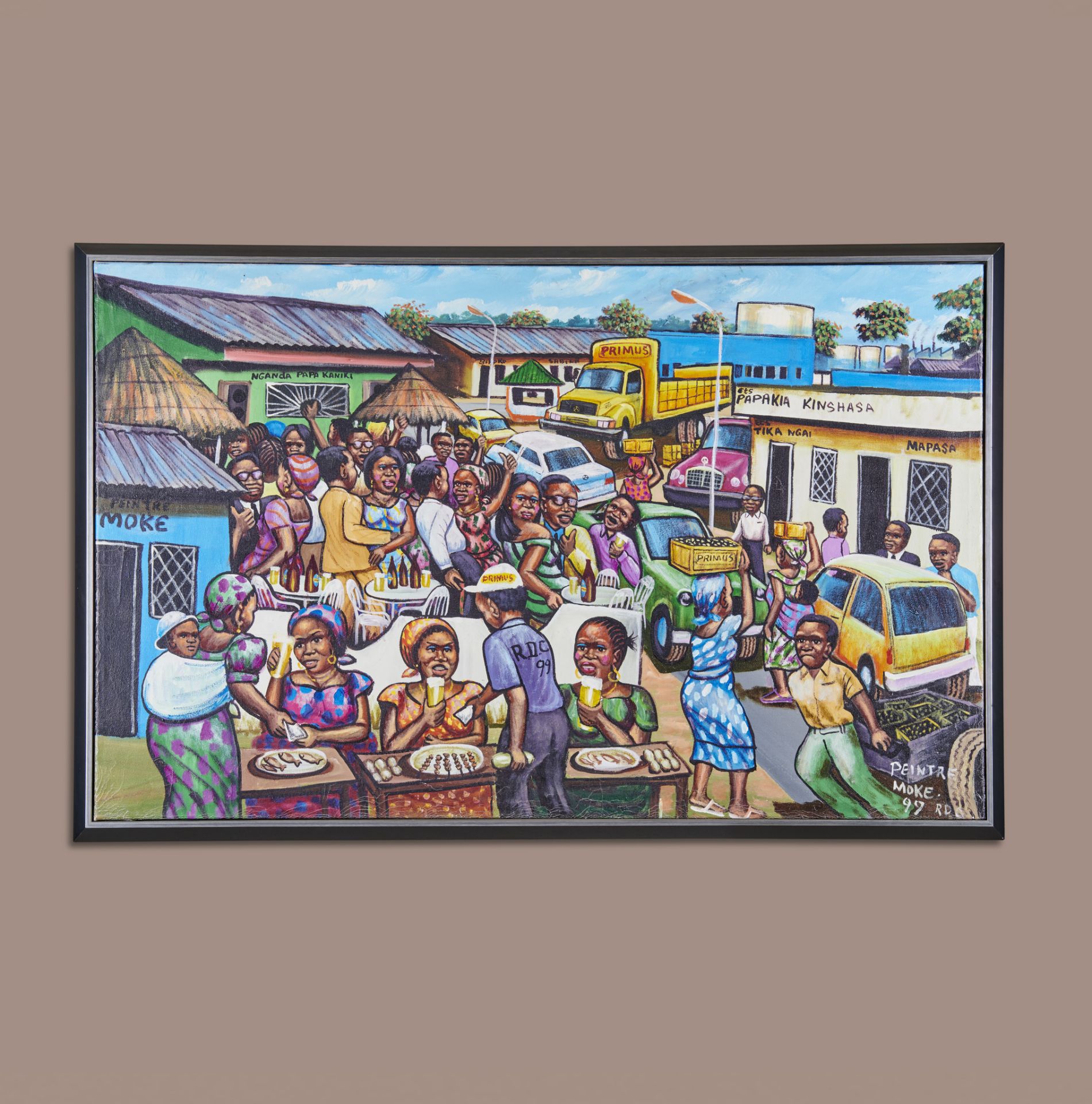
Moke, Take off pick up(?)
1999
Acrylic paint on canvas, wooden frame
outside frame 99 x 154 x 4 cm
Art in Kinshasa
This painting of a street scene in Kinshasa is a glorious feast for the eyes. On the left, Congolese men and women dance on a packed terrace near the Primus Brewery. On the right, a line of cars squeezes through a busy street, while an oncoming Primus truck pulls out of the brewery yard. Women carrying Primus beer crates on their heads weave their way towards the brewery and, in the front right, a man pulls a handcart laden with beer crates through the city bustle. The three merchants and their customers, at the very front, make the background seem more distant, giving the scene depth.
According to the inscription on the back behind this cheerful work, the artist gave it the title Take off pick up. He was the world-famous Moke (pronounced Moké), who was born in Congo as Monsengwo Kejwamfi (1950-2001). Along with other figurative artists, including Chéri Samba and Sim Simaro, Moke belonged to the group 'School of Popular Painting' in Kinshasa. He drew inspiration from everyday life in the Congolese capital – from market scenes to outdoor festivals and military parades. Dubbed a naïve painter by the established art world, he considered himself and was rightly seen as a 'reporter painter.' His work can be found in major collections.
Survival
Moke arrived in Kinshasa from the Congolese countryside at the age of ten. To survive in the city, he started painting on cardboard, following the example of the many artists he saw selling their work on the streets of the capital. When the country's dictator President Mobutu saw a portrait of himself by Moke in 1965, he offered the boy a scholarship. This and the support of several foreign patrons accelerated Moke's career.
Heineken's health clinic
Moke’s painting Take off pick up hung for many years in the health clinic that Heineken established at the Primus Brewery in Kinshasa. Heineken opened the first brewery in the then Belgian colony as early as the crisis years of the 1930s, using shares in the Brussels Brasserie de Léopoldville. Five more Congolese branches followed, which after 1957 came under the name Bralima (Brasseries Limonaderies et Malteries Africaines). After independence from Belgium in 1960, the new government accepted Heineken's presence in the Democratic Republic of Congo. In 2026, HEINEKEN announced its departure from the Democratic Republic of the Congo.
Africa Foundation
Heineken takes good care of its staff and their families in the Democratic Republic of Congo and other low-income countries where it operates. Global health and safety have been a spearhead of company policy since the late nineties. In 2007, Heineken also set up the Africa Foundation for sub- Saharan countries where basic healthcare is inadequate and citizens do not have access to clean drinking water.
Initially, the Foundation achieved many successes through its Mother & Child Care and WASH (Water, Sanitation and Hygiene) programmes. Today, the HAF supports smallholder farmers in building climate resilience and improving livelihoods through regenerative agricultural practices.
Successor
The artist Moke died in 200, just 51 years old. His worthy successor is his eldest son Moke jr, who specialises in 'Kinoiseries': paintings of the Kinoises, the inhabitants of Kinshasa. Following the closure of the health clinic in 2021, the portrait of his father was donated to the Heineken Collection.