

INFO
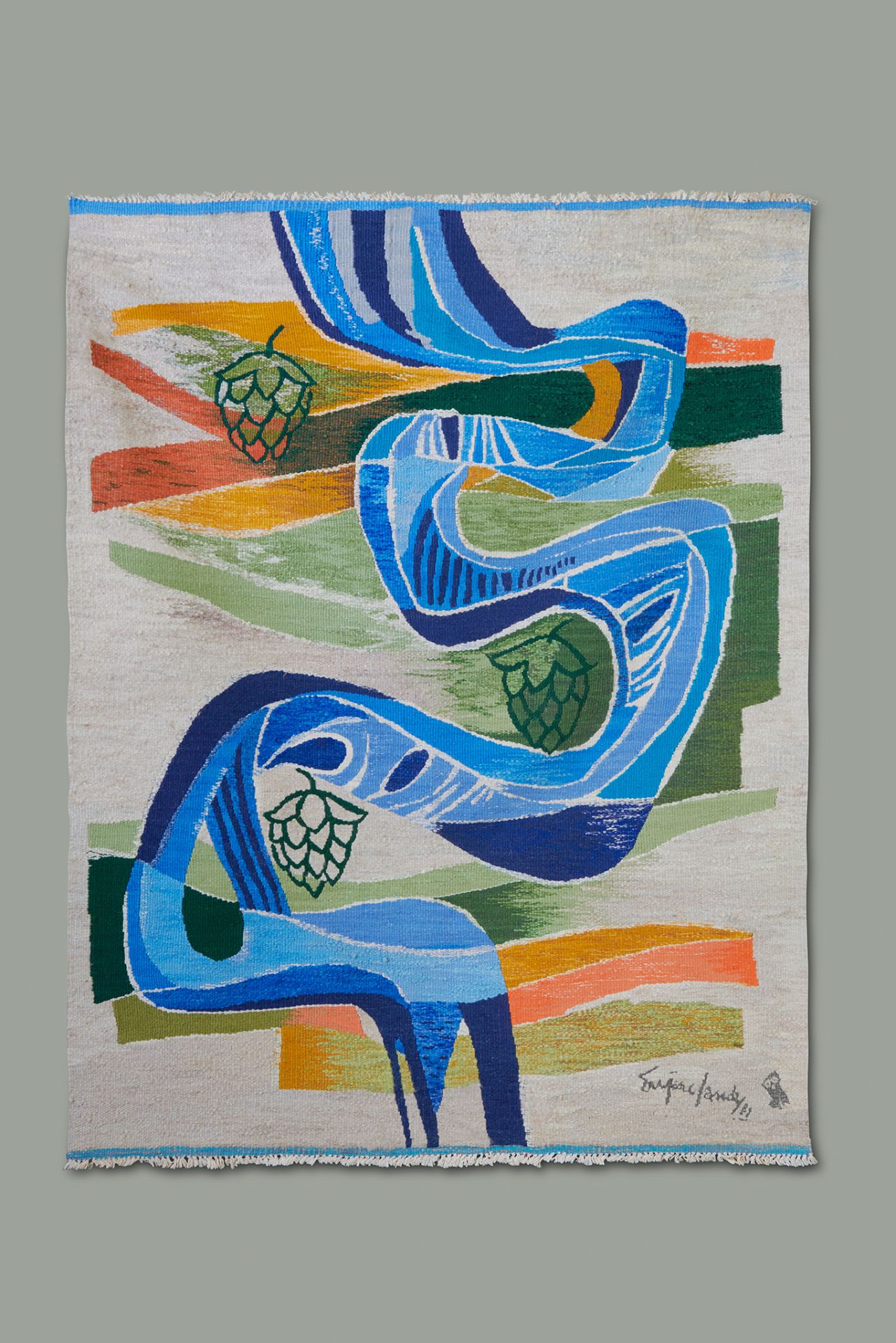
Tapestry depicting the Geul Valley and 3 hop cones
Eugène Laudy, woven by Weverij De Uil
1965-1971
wool, cotton
h 170 x w 132 cm
Limburg beer art
The tapestry affords an abstract impression of a winding river through hilly terrain with three hop cones. The symbolism? The river represents the Geul, while the hop cones symbolise the three breweries from north to south: De Leeuw (Valkenburg), Brand (Wijlre), and Gulpener (Gulpen).
Artist
Eugène Laudy (Heerlen 1921-1995) received the commission for this monumental tapestry design from Brand’s Bierbrouwerij. It would not be his last: in 1975, Brand released a portfolio of six pen drawings by Laudy, in collaboration with the Dutch Mill Foundation. This provides a useful comparison, as the drawings of Limburg watermills are less abstract and symbolic, focusing more on figurative and realistic elements.
Eye-catchers
According to a local newspaper, 'Brand beer brewer's advertisements are artistic eye-catchers. Not only do they boast about the beer “the pride of Limburg,” but also with the architectural heritage that rightfully swells the pride of the true Limburger.' The drawings from Brand’s nine-part series 'The Beauty of Limburg' were primarily created for commercial purposes. Still, then-director Guus Brand also recognised the general importance of art and culture. Brand, De Leeuw, and Gulpener traditionally contracted Limburg artists, even for projects beyond the advertising world.
Monumentalist movement
The stylistic differences between Laudy's artworks – both in style and technique – reflect his versatility. Trained in monumental art at the School of Applied Arts in Maastricht, he started as a young artist designing stained-glass windows for churches. Later, he joined three professional associations: the General Christian Artists Association (AKKV), the Association of Practitioners of Monumental Arts (VbMK), and Creative Craft Limburg. He and his fellow members considered themselves craftsmen, rather than independent artists, in service to Catholic society. They created mosaics, reliefs, murals, and stained-glass windows for public buildings, hence their name the 'Monumentalists.' Their typically Limburg community art aimed to educate the population in beauty and moral (religious) norms.
Tapestries
Laudy's church commissions declined in the 1960s and he diversified into various art techniques, including drawing, and designed numerous tapestries for schools, companies, and hospitals. He had them woven at De Uil in Amsterdam, a weaving mill that traditionally attracted many artists. Most of Laudy's tapestries have not withstood the test of time, but the one depicting the Geul and the hop cones was discovered by Heineken employees in the attic of the Wijlre rectory, which, after the acquisition by Heineken in 1989, became the taproom for Brand Brewery.
The tapestry arrived at the Heineken Collection Foundation in exceptionally good condition. After being carefully cleaned and fitted with a hanging system by the Foundation’s textile conservator, it was ready to take centre stage. In 2023, it could shine once again in all its glory at the Eugène Laudy retrospective in Museum Valkenburg.