

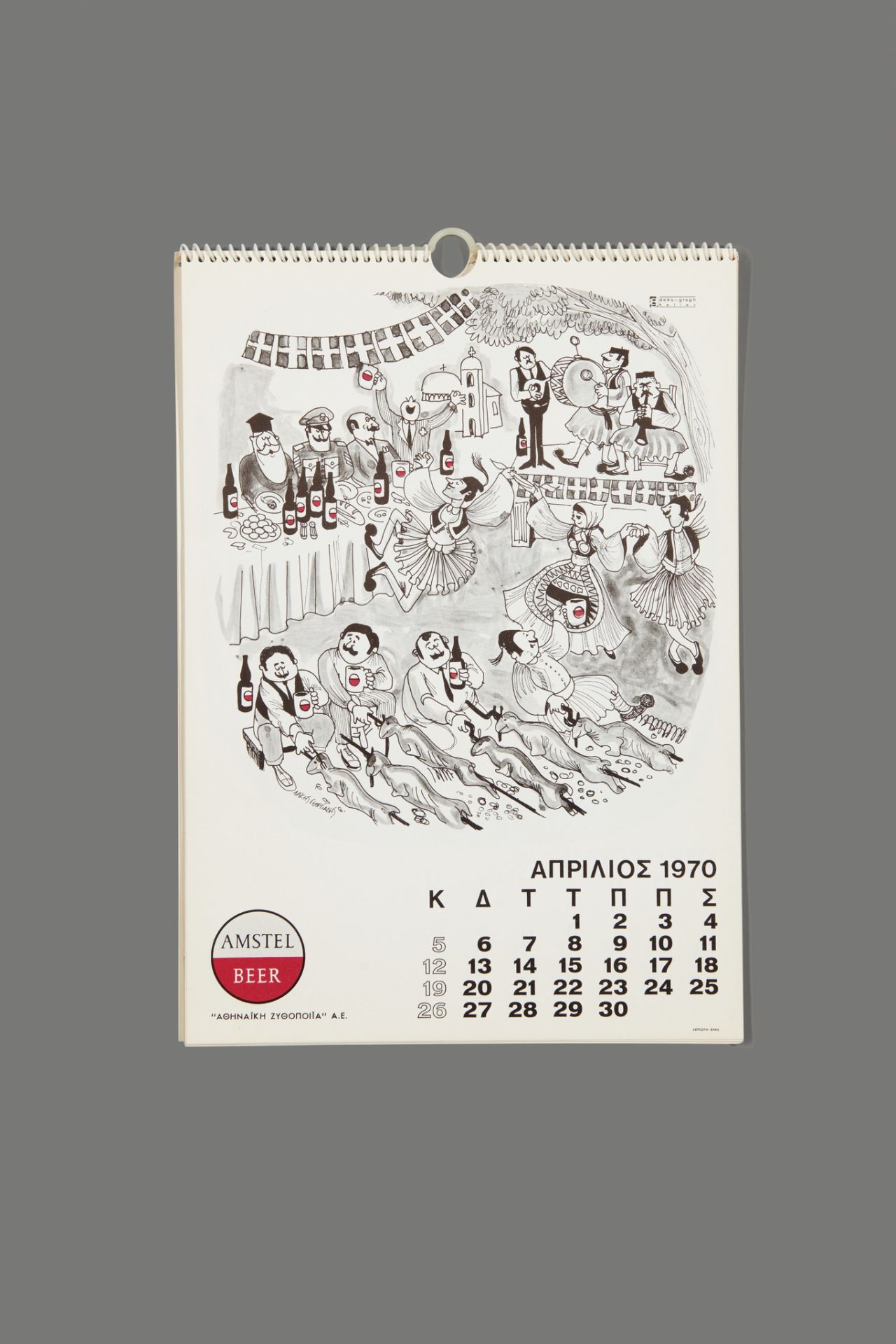
AMΣTEΛ under a tree
A page from a calendar for December 1970: a tipsy Santa dances on a table surrounded by cheerful men and women. They raise a tankard with a familiar red-and-white logo, which is also at the lower left with the brand name 'Amstel Beer'. The month and weekday abbreviations are not in English, but ... Greek.
Greece is one of the oldest and most important European markets for Amstel Beer. Today, Amstel is still the beer Greeks drink most, followed by Heineken and Mythos.
In 1965, Amstel opened a brewery in the city of Egaleon, near the Greek capital Athens. Heineken acquired a majority stake in the brewery after it took over De Amstel in 1968: Αθηναϊκή Ζυθοποιία or the Athens Brewery.
Drinking in company
Greece has a long tradition of drinking in company, where its primary role is to strengthen family and social bonds. And yet you rarely encounter a drunk Greek. If someone does get drunk, the group ensures that it doesn't become a nuisance. If you go for a beer with Greeks, you don't order for yourself, you order together and share.
From wine country to beer country
Influenced by tourism, more and more Greeks switched from wine to beer in the 1960s. It wasn't long before the Athenian Brewery was unable to meet the growing demand for Amstel beer. That's why, in 1967, Amstel built a large malting plant at Egaleon, which had to be expanded just four years later. The malting plant sourced as much barley as it could from Greece itself and Amstel led experiments into local barley cultivation at various locations in the Greek archipelago.
Novelties
In 1974, Heineken opened a second Amstel brewery fitted with the latest technology in the northern city of Thessaloniki, Greece's second largest city. The site included a 'static' malting plant, where the barley germination process took place in kilning rooms and not at other locations. Another novelty was that the air that passed through the germinated barley grains during the kilning process was heated using a heat exchanger, through which hot oil flowed, rather than by burning oil or gas.
Three-brand policy
Early in 1981, Heineken launched its own Heineken beer in green bottles and cans onto the Greek market, alongside Amstel beer, in a move aimed at staying ahead of international competition from Carlsberg and Löwenbrau. From then on, the Athenian Brewery pursued a two-brand policy, with Amstel remaining the market leader. After Heineken's takeover in 1989, the Limburg brewery Brand also entered the market as an imported beer. So now there was a three-brand policy.