

INFO
Gramophone records, sheet music, and music cassettes from A.F. Heineken
Various dates, a.o. 1963
c. 1985
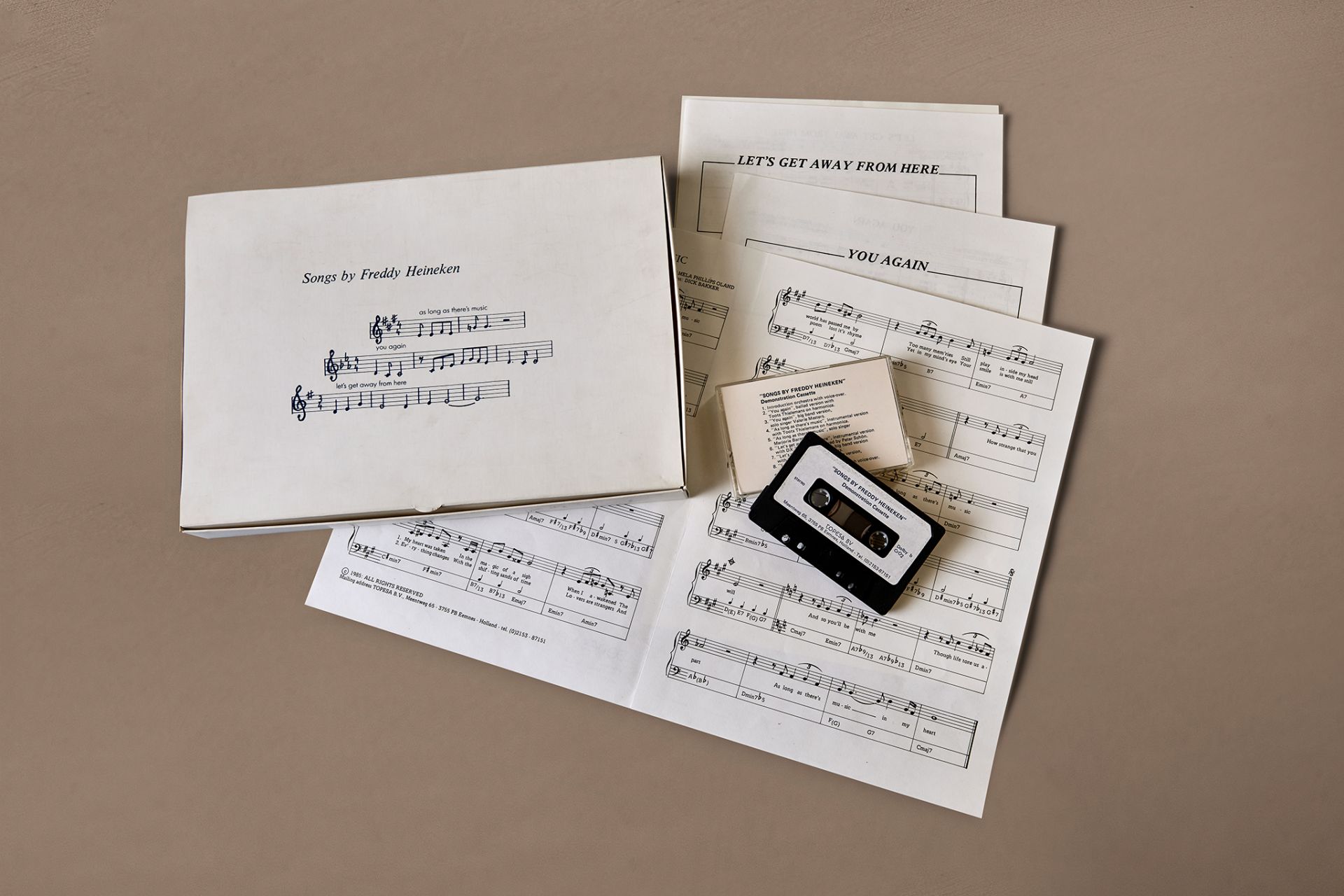
Going with the music flow
In the depot of the Heineken Collection Foundation are two containers with old-fashioned gramophone records, along with a box of sheet music and (who still remembers them?) cassette tapes: the remains of Henri Pierre and Alfred (Freddy) Heineken’s music archive. Its unassuming appearance notwithstanding, this stack conceals a treasure trove of information about a musical father and son.
When considering the Heinekens, many people immediately think of jazz. The Heineken executive was indeed a passionate jazz enthusiast, spending numerous hours at the bar of Hotel de l’Europe (now 'Freddy’s Bar') in Amsterdam, listening to the resident pianist.
Like father, like son
Freddy's musicality didn't come out of nowhere. His father, Henry Pierre Heineken, initially aspired to be a musician. Despite strategically choosing to study chemistry – with an eye to a future role in his father Gerard Adriaan's brewery – his passion for music never waned. Henry remained an excellent classical pianist, and Freddy grew up with two pianos at home: a Bechstein for Beethoven and a Pleyel for Chopin. Classical luminaries like violinist Yehudi Menuhin and conductor Bruno Walter were welcomed guests at the Heineken household. For many years, Henry served on the Board of Directors of the Concertgebouw, eventually becoming its chairman. Of particular interest in this context are about 20 copies of the single ‘A Dutch Treat from Holland is Heineken’s Beer’ in Alfred's legacy.
Jingle single
This recording is a radio commercial jingle performed by the Concertgebouworkest under the direction of a young Bernard Haitink (1929-2021). The jingle single, intended to promote Heineken beer in the United States, was released there in 1958 by sales promoter Leo 'The Dutch Baron' Van Munching. He was the man who taught Freddy Heineken the ropes of advertising shortly after World War II. The jingle aligns perfectly with Van Munching's marketing strategy, emphasising the exclusive nature of this 'exotic' pilsner to make Heineken big in America.
Songwriter
Then there is Freddy's personal contribution to music history. As a songwriter, he collaborated in 1993 on ‘Songs by Freddy Heineken,’ an album also present in cassette form on the shelf in the depot. This production by Dick Bakker features Kenny Colman, Toots Thielemans, Laura Fygi, and The London Studio Orchestra, sounding exceptionally professional, and this is not surprising. In addition to Freddy's efforts to put his father’s company on the map internationally, he dedicated as much free time as possible to writing lyrics and music, and producing jazz records.
Passionate
Nevertheless, after Freddy's death in 2002, no obituary mentioned his skills as a songwriter. This was corrected three years later with 'Freddy Heineken. He Brew,' an article in The Parisian Jazz Chronicles. Mike Zwerin reminisced about collaborating with American clarinettist-saxophonist Michael Moore for the ballad album Dreamscape, recorded in Freddy's studio on Blaricumse Bierweg. Besides being portrayed as a lover of 'bad jokes,' Heineken is depicted as a passionate, no, obsessed jazz expert and enthusiast, surrounding himself with renowned jazz luminaries. Heineken described himself to Moore with this anecdote:
‘Do you know the story about the musician’s baby? Right after it's born, they put it on its back. There's a violin on the left side, and a pile of gold coins on the right. If the baby reaches for the violin, it's going to be a musician. If it reaches for the coins, the baby is going to be either a banker or a thief. If it grabs both, then it's going to be a songwriter.’
Rebellious jazz
With this, Freddy was indirectly referring to his musical upbringing by Henry Heineken: a 'top-notch classical pianist,' but (according to Freddy) 'with that kind of music, I always knew what was coming next. I like to be stirred up, surprised. And that's what jazz is all about.' In Henri Heineken's household, the new Afro-American music style was deemed 'vulgar,' providing Freddy with the perfect means to distinguish himself from his father. The brewer’s son had already been expected to follow in his father’s footsteps in so many ways...